
When it comes to building a happy and meaningful life, most of us rely on a grab bag of strategies — habits and goals around work, relationships, and health. But my guest today would argue that in the quest for true flourishing, there’s a deeper element that not only ties together those efforts, but organizes and energizes them: purpose.
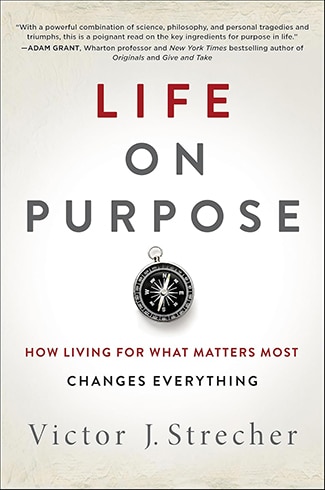
Vic Strecher is a professor of public health, a behavioral scientist, and the author of Life on Purpose: How Living for What Matters Most Changes Everything. We begin our conversation with Vic’s powerful story of how losing his 19-year-old daughter led him to discover how purpose can fundamentally reshape your life. Vic then unpacks the dramatic impact purpose has on your physical and mental health. He shares some guideposts on finding your own purpose, what kinds of aims foster the most fulfillment, why finding purpose isn’t a one-and-done process, and why becoming purposeful can make life feel less like a tug-of-war and more like stepping into a strong current that carries you forward.
Resources Related to the Podcast
- The Purposeful app
- AoM Article:The Power of Purpose
- The 5 Best AoM Podcast Episodes on Finding Meaning and Purpose
- AoM Podcast #1,051: Man’s Search for Meaning, With Viktor Frankl’s Grandson
Connect with Vic Strecher
Listen to the Podcast! (And don’t forget to leave us a review!)





Listen to the episode on a separate page
Subscribe to the podcast in the media player of your choice
Transcript
Brett McKay:
Brett McKay here and welcome to another edition of the AoM podcast. When it comes to building a happy and meaningful life, most of us rely on a grab bag of strategies, habits, and goals around work, relationships, and health. But my guest today would argue that in the quest for true flourishing, there’s a deeper element that not only ties together those efforts, but organizes and energizes them: purpose. Vic Strecher is a professor of public health, a behavioral scientist, and the author of Life on Purpose: How Living for What Matters Most Changes Everything. We begin our conversation with Vic’s powerful story of how losing his 19-year-old daughter led him to discover how purpose can fundamentally reshape your life. Vic then unpacks the dramatic impact purpose has on our physical and mental health. He shares some guideposts and finding your own purpose. What kinds of aims foster the most fulfillment? Why finding purpose isn’t a one or done process and why becoming purposeful can make life feel less like a tug of war and more like stepping into a strong current that carries you forward. After the show’s over, check at our show notes at aom.is/purpose. All right, Vic Strecher, welcome to the show.
Vic Strecher:
Thank you so much, Brett.
Brett McKay:
So you are a professor of public health and you have spent a lot of time researching and writing about the role purpose plays in our overall health and wellbeing. How did that happen?
Vic Strecher:
Well, I am a behavioral scientist. I think for my whole career I’ve been trying to understand root causes of why we do the things we do. And in public health, of course, we may be helping people quit smoking or manage their stress or their weight or get a mammogram or so many different things. So often we end up scaring people saying, if you don’t do this, bad things will happen. If you don’t quit smoking, you’ll die. If you don’t manage your diabetes, you could lose your legs, blah, blah, blah. And the more I approached behavior in that way, the more I realized that people’s defensive shields just kind of pop up. And naturally I do the same thing. Somebody tries to scare me. I say, well, that’s not like me. That’ll never happen to me. And I start even discounting the person saying it. So I started really thinking more about root causes.
And this is through a lot of experience. A person may come into a smoking clinic I’m running and say, I don’t need this clinic. I don’t need this fancy cognitive behavioral program you’re running. Because my kids just stopped me while I was driving them to school and said, dad, your smoking bothers me so much. And I realized, what am I doing? I’m a dad, I’m a father, and so I don’t need your program anymore. And I used to say something like, well, of course you need it because one little simple motivational event isn’t going to change you. Well, I found that those people change and they change for life. So some deeper root cause, some identity shift or understanding who they really are, understanding and appealing to one’s core values that turns out to be really, really important. And I guess in my own life, I went through a difficult experience that kind of caused me to take a dramatic shift in my own behaviors as well.
Brett McKay:
Tell us about that. You start off the book talking about your daughter, Julia, can you tell us her story?
Vic Strecher:
Sure. Well, my daughter, Julia was born healthy in 1990. She used to like to say “I was a 10 out of 10,” and then six months into her life when she was a little baby, my wife and our older daughter and Julia were in the Netherlands. I was on a research sabbatical there. And so doing intense research with people, but at the same time, our daughter, Julia started losing weight. And you’re not supposed to be losing weight when you’re six months old. You’re supposed to be gaining weight. And so eventually after seeing a doctor, then another doctor finally, she ended up in the hospital. A cardiologist walked by after her being in the hospital for a few days and just thought, she doesn’t look right. They did an echocardiogram on her just to see what her heart was like. And it turned out that her heart was completely ruined.
She had gotten a chickenpox virus out of the blue like most of us do, and it causes a fever and a rash usually for a day or two. But this chickenpox virus attacked her heart and it destroyed it. And we were told that she was going to die within a month. So we literally took her out of the hospital in the Netherlands and the next morning we flew home and the people at home, we went to a medical center where I was a professor at the time, and they said she may actually be eligible for a heart transplant. And of course, I was an assistant professor. What did I know? I was living a comfortable assistant professor life, trying to get tenure, writing grants, publishing articles, the standard stuff, and didn’t really take my life terribly seriously, Brett, just to be honest, I was in my early thirties and I just thought, this is pretty easy and I’m enjoying it, and this is going to be a nice easy go of it as a life is concerned, I guess.
And suddenly everything shifted. I started realizing that our lives are all finite and we don’t know how long any of us are going to live, but also I had to take her life very seriously. So we as a family decided to list her for a heart transplant, and she became one of the early children to get a heart. But looking at the research data, which I’m a researcher, so I look at the data and there wasn’t a lot of data, but what did exist showed that kids who are waiting for a heart, only about 50% of them ended up getting a heart. They died before getting one half of them. And then if you did get one, if you’re that lucky, half, then half of those kids ended up dying within five years. So I thought her chances of becoming even six years old are about one in four.
So in deciding to list her for a new heart, we had to decide what kind of life should we give her? And it became an existential question for our family. How do you live a life? And so I started thinking about it then and we started, she did get a heart and new heart, and it was almost like she got a brain transplant because she had more energy. She just turned alive suddenly as opposed to just shrinking. And we as a family, I’m sorry, I get a little emotional thinking about this . . . But as a family, we started saying to ourselves, look, we don’t know when she’s going to pass away, but then we don’t know any of us when any of us are going to pass away. So let’s live our life as if this may be our last day or our last week.
Let’s live every moment, make every moment we can, filled with gratitude and filled with caring for what we care about. And so we started living very differently and suddenly all of our lives, not just Julia’s life, but all of our lives started turning technicolor as opposed to simply being black and white. And I think I lived a black and white life before then. Quite honestly. Things were pretty easy. And suddenly when they became very difficult and challenging, that’s when life became really interesting, quite honestly. She ended up needing a second heart transplant when she was nine, but when she was 19, well, she wanted to be a nurse. She wanted to give back. She had been in the hospital a lot. Just getting a heart transplant doesn’t mean you’re fully able to do anything that others are able to do. She was in the hospital a lot.
She had headaches a lot. She had issues that she was immune suppressed, so any illness would really be difficult for her. And my wife took a major caregiving role then, but she wanted to be a nurse and give back. She got into nursing school at the University of Michigan, and her first semester was pretty tough, and she was 19 at the time. We decided to go down to the Caribbean just so that she could warm up. We live in Michigan, it’s pretty cold up here. So we went to the Caribbean. We took our older daughter as well. We were all out on the beach having dinner and being grateful for where we were quite honestly. And when we were all going back, we were just very close. And her last words were, I am so happy that I could die now. And she went back to her room and those were her last words, it turns out.
And so when that happened, when she died, I went through a deep grieving process, as you might expect. I almost thought she had some significant future, that she was kind of a miracle child in a way. And my bubble was burst, obviously. And I went through a deep depression. I went up to northern Michigan. We have a cabin up in northern Michigan, right on Lake Michigan, if you’re familiar with that. And Lake Michigan is almost like the ocean if you’ve never seen it before. It usually has great big waves. And this is a few months after she had died. And I’d been by myself for about a month just figuring things out, frankly. But I wasn’t really figuring things out. I was just eating and drinking myself to death. I was falling asleep in front of the TV. I started just watching things that were stupid, just any dumb TV. I started trying to figure out what Kim Kardashian was doing. And to me, I thought, wow, that’s a sure sign that you’re getting ready to die. That’s all you care about what Kim Kardashian is doing or what influencers are doing or what’s on television all the time, or the latest sporting event. Not that they’re not important, and I’m sure Kim Kardashian is a nice person. It’s just why do I care about these things?
And I went to bed and I had been really drunk the night before. I just went to bed. I had this huge dream early in the morning, and I dreamt that my daughter was with me, and she was only nine. And we were in the Netherlands in this little town called Morich where I was working, and it’s a beautiful medieval town, and we’re on rollerblades and rollerblading around the town. And we saw this beautiful, huge, huge building. And it looked like a church. It could have been a mosque, it could have been a synagogue, but it was beautiful. It was beautiful white marble, and it was glowing. And Julia said, we need to go there. And I said, great. It’s beautiful. Let’s go. And we were rollerblading there. And then we went into the entrance and there was this circular staircase in my dream that went down and down and down infinitely it seemed like.
And Julia said, let’s go. And I said, we’re on roller blades, Julia. We can’t just pop down. She said, don’t worry. And we started floating down and we went into this. At the bottom of the staircase was this huge room. And my daughter, who was rollerblading with me, she had passed away when she was 19, but she was nine in my dream. And she looked up and just looked at me. And then I looked out and there were these three beautiful women, and they’re all wearing these beautiful purple dresses. And they all three approached. And suddenly I turned to my daughter and she wasn’t nine anymore, she was 19, and she was wearing the same dresses they were. And she turned to me and said, I’ve got to go. And I said, no, don’t. And she went with these three women and they disappeared. I woke up in the morning and my pillow was soaked in tears. I was trying to get back to sleep thinking I’ve got to get back to sleep. I’ve got to see her again. I don’t know if you’ve ever Brett had a hyper vivid dream where it’s so vivid that you could swear it was real.
And this was very real to me. It turned out to be about five o’clock in the morning, and I looked out and it was still dark outside. I could hear Lake Michigan a little bit, and I just hopped out of bed. I was just in my boxers and t-shirt and jumped into my kayak, which is out on the beach. And I didn’t bother with any sort of life preservation equipment, which is really stupid because it was still springtime.
Brett McKay:
And you’re a public health professor…
Vic Strecher:
And I’m a public health professor, Brett, right. This is dumb as it gets. And I don’t know why I went out there, honestly, but I just hopped in my kayak and it was beautiful. Unlike the way it’s often where it’s like an ocean. It was perfectly smooth, but it was still dark and it was foggy, and the water was like a slurpee. You could still even feel ice crystals in it. And again, just in my boxers, and I jumped in my kayak and I just started paddling like crazy, like a mad person, which I was, I think straight out straight heading toward Wisconsin. And I found myself, I’m guessing around two miles out when the sun came up and I was paddling and paddling. And then when the sun just came up, all of the water started glowing, just these fleck of light everywhere.
It was magical. And I stopped my kayak and I turned and I just looked at the sun coming up. And actually my thinking before the sun came up was to continue kayaking to Wisconsin, which is 84 more miles. Of course, I never would’ve made it. And like you said, I’m a public health person, but that’s where I was in my head. I saw the sun come up, and I don’t know how to express this other than to say Julia was in me, and she was telling me, you have to get over this. You have to get over this dad. And it wasn’t like, you have to get over this. It was like, you have to get over yourself. You have to get over your ego. And at that very moment, I had this epiphany that I really had a choice. It’s almost like if some street sign lifted up right out of the water, which is hundreds of feet deep already and said, death or life, that’s what was happening to me.
I could choose either one. And actually it was kind of freeing to be able to choose what I wanted to do. Before then, I felt like I wasn’t choosing anything and I was just kind of heading toward my death, whether it was drinking myself to death and watching stupid television or actively dying by kayaking to Wisconsin. But of course I’m here talking to you, Brett. And I decided to turn back and I got back and I was kind of dripping. I didn’t feel any cold. I just sat down at the kitchen table again, I’d been by myself. I almost felt like I was looking down from the ceiling of our kitchen and telling myself, I started just saying, Vic, you’re in some deep trouble right now. You’re in really deep trouble and you’re going to die if you continue on this path. You have to fix yourself.
You’re a behavioral scientist. If you can’t fix yourself, what good are you? Anyway, and I almost looked at my therapist self and said, Vic, you’re right. So I’m going to pull out a sheet of paper, which I did. I started writing just very quickly the things that mattered most to me. And I don’t know why I did that. I hadn’t been thinking in that way. I just started writing them down. I wrote my family, my wife, our older daughter Rachel. I started writing my friends names down. I started writing about what mattered to me at work. My students matter, my work matters. I decided to, for some reason, I circled my students and the university had given me a break. They said, you don’t have to teach this semester. You don’t even have to teach next semester if you can’t do it. I mean, you’ve just gone through one of the worst things a person can go through.
But I started thinking about my students, and I called the university that morning then and called my department and said, look, it’s so kind that you gave me the semester off, but actually it’s not the advice that I need. What I need to do now is teach, and I want to teach every one of my students as if they’re my own child. And I got back, I went back. I started teaching my students as if every single student was Julia, looking out at them. I even would take a couple big deep breaths and I would look at them and just see my daughter’s face in all of them and just tell myself, you’re going to be teaching today as if all of these people have their own needs, their own lives, their own concerns. And when I did that, my teaching changed and my life changed.
I was nominated to become the professor of the year, for example, at Michigan. All these things that I didn’t expect, didn’t think I really deserved. Suddenly all these things happened because I started caring so much about my students. I also started taking care of myself because I have hundreds of students, and that’s just grown. So I realized I needed energy for my purpose. So I started sleeping better. I started trying to eat better. I meditate every day. I started doing things that would hopefully give me more energy. I’d walk to work every day. I needed energy because I had a big purpose. And I realized, wow, I’m actually changing my health behaviors because I have a purpose. And I started doing research on this. Have other people found this? And sure enough, it turns out the purpose is this. If it were a drug, it would be a miracle drug. It helps so many different things. So I started treating it as a research topic. Luckily, there is a person in the psychology department who is looking for a mentor for his dissertation. He asked me if I would do this, and I said, of course I’d be happy to. And with him, I started learning so much more about purpose. And since then, and that was a long time ago, it’s about 15 years ago, I’ve just simply devoted my life to helping people find greater purpose and metaphorically getting out on the dance floor of life.
Brett McKay:
Well, thank you for sharing that story. That was really touching. And like you said, I think the takeaway from that, your behavioral scientist, and typically when you read articles from behavioral scientists, they always offer these tips on how you can change your use reframing or use implementation intentions.
Vic Strecher:
Oh, wow. Yes.
Brett McKay:
All of these things.
Vic Strecher:
Acceptance and commitment therapy.
Brett McKay:
Yes, exactly. But what you learned from your own experience with your daughter, Julia, twice including that first time when she got her heart transplant, is that if you have this purpose, it’s this lever you can pull that just causes you to change. And then you learn that again a second time with her passing, that if you have this overarching purpose that’s going to do more for you than all these little cognitive behavioral therapy hacks,
Vic Strecher:
It’s pretty amazing. To me. It truly feels like, somebody recently asked me, what’s it like to feel purposeful? And I thought, what a great question. I hadn’t really thought about that. And I thought for just a few seconds and said, it’s like jumping into a river that has a strong current and that current is moving forward. And as you’re moving forward in this, things become easier. You’re not fighting against things and you’re choosing clarity. So suddenly the world becomes much clearer and there’s less conflict in your life. You’re not wondering, what should I do here? Should I play with the kids or should I have that old fashioned? It depends on what your purpose is. Maybe your purpose is to be an alcoholic, in which case you pick the old fashioned, but typically it’s not. Typically it’s I’m going to play with those kids. And so you put off that old fashioned and you also start thinking, how can I be a better dad? Which I think is incredibly important. And then from that river, you may find streams that move off of that river and you say, that stream looks really interesting. I think I may jump into that stream. And that’s been my life for 15 years now, since I found a very strong purpose or set of purposes in my life. I’ve found my life incredibly joyful, quite honestly, and very happy.
Brett McKay:
Well, how do you define purpose personally, but also with your research? What does it mean to have a purpose?
Vic Strecher:
Great question. Thanks for asking that too. So having a purpose is being value driven, first of all. And what psychologists or other people who study purpose real carefully, they like these academic definitions often, and they might say it’s a values driven self organizing framework for determining goals and channeling your energy. So working through that values driven meaning, this is led by our core values, and I’d love to talk about that a bit more, meaning it’s not other organizing. Somebody else is not telling you what you should be doing. And you referred to Friedrich Nietzsche. Nietzsche was all about you creating your own purpose in your life. You’re a camel person. You say, educate me of all the joys and the sorrows of the world. And then that camel metamorphosize into a lion goes into the wilderness and finds this dragon that says, thou shalt on every scale.
The lion defeats the dragon, basically saying, I’m going to create my own purpose. I’m not going to listen to what everybody else says. And sure enough, I tell my students in the first day of class, many of whom are freshmen, say, A lot of you come in here essentially with your resume that’s been written by your parents and your back pocket. You’re going to be a doctor, you’re going to be this, you’re going to be that. I want you to pull that resume out, and I want you to tear it up because if you’re going to be a doctor, you need to decide to be a doctor. If you’re going to be a business person, if you’re going to be a lawyer, if you’re going to be whatever, you’re going to be an artist, whatever you’re going to be, you’re going to decide. And that’s essential, or you won’t be happy.
You won’t be successful. You need to create your own purpose in your life. So that’s what’s meant by self-organizing. And then purpose helps you organize your goals. It gives you clarity. In this morass, everyone’s trying to get you to set a certain goal, usually around their own thing, their own cause, their own thing. They’re trying to sell, create your own goals, but those goals come from your values and from your purpose. And that’s where you start channeling this most precious resource that you have, which is your energy and vitality, and you start moving your energy into that. But it becomes easier because sorry for all the metaphors, but you’re in this river with a very strong current and you’re not fighting it, so it becomes easier.
Brett McKay:
Yeah, I’d like to return to how people can figure out the purpose, and it involves figuring out values, figuring out goals. But before we do that, let’s talk about the research you’ve done on purpose, because you highlight some really interesting research that shows how purpose affects different facets of our health. And you wouldn’t think, well, why would purpose influence my, I mean, people would understand how it influence your mental health, but my cholesterol, my heart disease. So tell us about that. How does having a purpose affect our health? What does the research say?
Vic Strecher:
Wonderful question. Thank you. So first of all, as I was alluding to before, if you have a strong purpose, you start taking care of yourself more. So we find in many, many, many surveys that if you have a strong purpose, you’re less likely to engage in unhealthy behaviors and you’re more likely to adopt healthier behaviors, you’re more likely to get screened for cancer, for example, for example, getting a colorectal cancer screen, you’re much more likely to get that. You actually then spend fewer days in the hospital because you get sick less. Well, that’s not bad. So we know those things happen. Also, I’m so lucky to know some amazing neuroscientists. One in particular, Emily Falk, who just wrote a great book on, it’s entitled What We Value, but she’s a neuroscientist who studies people’s core values, and we’ve put people into MRI and have them think about their most purposeful core values.
And there’s a part of the brain that lights up that’s very modern. It’s right in the front of our prefrontal cortex, and it’s a part of the brain that relates to executive functioning, meaning executive decisions, high level decisions that we make. It also relates to the self. Who am I? What am I all about? It relates to our core values. Also, when this part of the brain becomes more active and we’re challenged, usually when we’re scared by something, there’s a part of the brain that’s very ancient, very old. It’s called the amygdala. This is our fear center, and that fear center gets very active and it can hijack our brain. When you think about your purpose, this prefrontal cortex gets active and it actually governs down our amygdala. It governs down our fear. If I think about James Bond, for example, in a Bond movie, maybe he’s being lowered into a vat of boiling oatmeal or whatever’s happening, and he’s going at first, oh God, this is going to be terrible.
And that’s what the audience is thinking. But then he finds some way out of it. So first his amygdala is going, but in this Bond-like heroic sequence, his prefrontal cortex starts lighting up. He’s going, I don’t have to be afraid of this. In fact, I have a solution to it. That’s what happens when you’re purposeful. So we know even what goes on in the brain. We also know that purposeful people have less activation in a part of the brain, a region of the brain that relates to conflict. So they’re less conflicted. They know what to do. As I was saying before, there’s other research that we’ve done looking at longevity, and we’ve looked at longevity a little differently. Now, there are literally almost a dozen studies that have shown that people who have purpose live longer, significantly longer. And this is after statistically adjusting for age and gender and income and education and all sorts of things.
You can’t make it go away. But we wanted to look at people’s biological clocks, what are called in scientific terms, epigenetic clocks. And these clocks are looking at how our proteins are expressed by our DNA. And we find that if you have a strong purpose, your proteins, more healthy proteins are being expressed, and unhealthy proteins are less likely to be expressed. And that can all be put together and form what we would call a biological clock. And sure enough, people with stronger purpose have longer biological clocks. This is really exciting for us because parts of our epigenome may even be inheritable to our children. So this is so valuable. I’ve continued to think all along as we do this kind of research, if this were a pill, it would be a gosh, it’d be a multi-billion dollar drug. It would be a magic pill.
Brett McKay:
And you also highlight research. That purpose is also associated with an increase in HDL cholesterol, which is the good cholesterol, and it seems to have something to do with the reduction in inflammatory cell production.
Vic Strecher:
Yes. So we find that, and this is other people’s research too, not just our own, but other people have found that people with a strong purpose in their lives have fewer pro-inflammatory cells and proteins produced very important because while we want some inflammation, it’s good if you get a cut or something, you want that to inflame and close the cut, right, close the wound. But if we have too much inflammation or chronic inflammation, we start getting everything from arthritis to heart disease, some cancers, and certainly all sorts of other problems. We know, as I said before, that people who have strong purpose take better care of themselves, they eat better, which also may contribute to this higher rate of the good cholesterol that’s in our bloodstream.
Brett McKay:
I’m just going to highlight some other things you highlight in the book, because I thought it was really interesting. People who have low purpose in life were 2.4 times more likely to develop Alzheimer’s disease than those with a high purpose in life.
Vic Strecher:
There are studies where they combine all the studies, put ’em all together because they say, well, one study may be nice, but it’s not going to convince the scientific community, especially something that’s as strange as well. People with stronger purpose are half as likely to develop Alzheimer’s. That seems crazy. How does that work? Now, there are eight studies of it, and they’ve been all put together, and they find that people with a strong purpose are far less likely to develop Alzheimer’s, and they’ve even autopsied people’s brains after this and found that people with strong purpose have fewer lesions, lesions that cause dementia, and, and in addition, there’s a new study that came out very recently in middle-aged men. So this is an important study for you and other middle-aged men listening to this because in middle age, very often, that’s when dementia or Alzheimer’s starts to form.
Purposeful people have much stronger connectivity within their brain, between different brain regions, far more. If you have a low purpose in your life, you tend not to have the connectivity needed. It’s hard to get the right metaphor, but maybe if you consider it kind of like pipelines, moving from one region of the brain to another, or circuitry moving from one region to another, we want that. We want our brains, different regions to be talking to one another. People with strong purpose have that much more. So, boy, I’ll give you one final set of findings, and this is with a good friend of mine, Ethan Cross, who wrote a really amazing book recently that’s out called Shift. And I think you even interviewed Ethan Cross.
Brett McKay:
We did, yeah.
Vic Strecher:
Yeah. So he’s a good friend and colleague. We did some research together. I said, Ethan, you do all this work on different coping strategies, and you have this cocktail of about 16 different coping strategies that a person could pick from. So we decided to look at those coping strategies, knowing some are not great for you. I’m going to drink alcohol when I’m stressed out. Just think about my own past or maybe really good ones. I know this won’t last forever. I’m going to take a walk in nature. I’m going to engage in a family or religious ritual. I’m going to see a big picture. It turns out that those positive coping strategies are strongly associated with having a strong sense of purpose in your life. Whereas negative coping strategies like I’m going to drink too much or eat too much, or vent, things like that, those are negatively associated with having a sense of purpose.
So you see the different things that it does. I was talking to a person who’s writing a new book related to purpose, and she said, I really think that having a purpose reduces entropy. The second law of thermodynamics, this entropic law that says everything gradually dissolves and gets less and less organized. We see a dead deer on the side of the road the next week, we pass that same deer. If it’s not gone, it’s looking a lot worse. It’s more and more disorganized. That’s entropy. What purpose does is it’s almost an entropy rebel. It almost reverses entropy. So I really think purpose is just that important, and we can build it, we can enhance it.
Brett McKay:
So in addition to all those health benefits, it can make you more resilient than some — that research you did with Ethan Cross. It can help you cope better. So it sounds like what purpose does the reason why it provides all these benefits? It sounds like there’s two things going on. One is having a purpose causes you to take better care of yourself. So you’re going to eat right, exercise, sleep, not drink, not smoke. But then also there are some physiological changes going on in your body.
Vic Strecher:
It sure seems like it. Yep, yep. There’s really good data showing that.
Brett McKay:
That’s amazing. Well, let’s talk about how do we develop a purpose? What does that look like?
Vic Strecher:
Well, one of the ways to find purpose is to do just what I did when I was coming back on my kayak and pulled it in, ran up to my cabin and pulled out a sheet of paper and started writing down the things that mattered most in my life. And that’s a great way to start. If you start writing down the things that matter to you, what do you care about? Philosophers like to talk about caring about what you care about. So start by figuring out what do you care about? And if you want, the easiest way to do that, maybe you even look on your smartphone wallpaper when you open up your smartphone. How many times do we do that? On average, it’s over 60 to 80 times. So for me, when I open mine, I see my granddaughter, Madeline Julia from our older daughter, and she’s just amazing.
And so I look at her every single day, about 60 times, at least a day. So that’s affirming who I am. It’s affirming who I value. It’s affirming who I care about and what I want to be alive for and active for, and devote my energy to and my goals to. So I teach a lot of physicians, and when I train physicians, I ask, what do you do with a diabetic? Who’s newly diagnosed? How do you get them to start doing the things they need to do because they need to manage their weight very often or work out more, eat better, blah, blah, blah, take their medications. And a lot of ’em say, well, we tell ’em they might lose their legs if they continue on the path they’re taking, or they will die early. Well, what does that do? It sets up this defensive wall.
What if you just simply said, what’s on your smartphone? Open it up. If you don’t mind, show me what’s on your smartphone. Chances are it’s something that matters to them. And then you just sit back and say, so what do you want to do about that? Suddenly, it’s a totally different reframing of the issue. So that’s one thing to do. Write down what matters most. Let’s say you write down 10 things, maybe drop it down to five, and then from the five, maybe drop it to three and you say, I’m here for these people. Usually the things that matter most are not things they’re people, but it may be a cause that you care about. Whatever it is. You may say, those are the things that I live for, and I am going to start building a purpose around those things. I’m here to be on this planet to do this, and now how are you going to end up doing those things?
And you start working that through. You start setting goals around those things. So that’s one way to think about finding your purpose, what we call values affirmation. It’s a part of, you’ve mentioned different theories and approaches. It’s part of what’s called acceptance and commitment therapy, where you are accepting the fact that bad things happen to everybody. I’m by the way, nothing special when I talk about things that have happened to me, things have happened to everybody. All you have to do is live a life and you go through adversity and difficult times. But if you let those hijack, you can do that. You can choose to do that, or you can say, what am I committed to? And suddenly these things become less relevant to your commitment to things that are most important to you. It’s almost like swimming in quicksand. The more you try to get out, the more you sink. So it’s important to not let the stressors in life every day. And we all know we have a lot of stressors in life right now, from everything from politics to media, all sorts of things happening in our lives right now. If you say, okay, those are important. I understand them, but I have a purpose. And that purpose may be multifaceted. You may have a purpose around your family. If you have a family, maybe around your work, maybe around your community, all sorts of domains you could build purpose around or purposes, and then you devote your life, literally, your life to those causes, to those purposes, then suddenly these stressors don’t seem quite so stressful.
Brett McKay:
I think this is helpful. I think a lot of people, when they think about finding their purpose, they think they kind of have to pull it out of thin air. But it sounds like finding your purpose is often a matter of looking at what you already do and finding ways to lean into it and be more intentional about it. Maybe you already have this friendship that’s important to you. How can you lean into it? How can you be a better support for your friend? Maybe you’re already a dad. How can you be more intentional about creating a family culture? What can you do to raise the most excellent possible humans in your job? You can find ways to see a real mission in it. So if you’re a doctor, you can find ways to treat your patients so they feel seen and not like a number. You talked about how you started taking teaching more seriously, treating each student like they were your daughter. If you volunteer in a church youth group, how can you lean into that more and make it the best possible group and create the texture of these kids’, childhood and faith? So yeah, it’s really caring about what you care about. And going along with this, you also talk about what can make purpose more powerful and lead to flourishing is finding purposes that are self transcendent. They move beyond the self.
Vic Strecher:
Yeah, yeah. There’s a big discussion about that in the research community, and there are a few people who say, well, it doesn’t really matter if your purpose is very hedonic or very transcending. A purpose is a purpose, and it’s good. Maybe to some extent that’s true, but there’s enough data showing me anyway very clearly that having a transcending purpose, a purpose that’s bigger than yourself actually makes you much happier. So the more you seek happiness through things, I’m going to sit on the beach for the next two weeks, and maybe that’s great. Maybe you need a break. Maybe you need to recharge the batteries, whatever. But if that’s all you’re seeking, then the next vacation, maybe a little less fun. Kind of like if you eat a great meal every single night, what if you had a gourmet meal every night? After a while, you’d start complaining more.
You’d say, I don’t know about that. I think the chef could have done a better job. Or for golfers out there, if you play golf every single day, after a while, it becomes less interesting, probably. That’s my guess. So yeah, just focusing on things that are focused on you and your own hedonic goals, I don’t think helps as much. Aristotle talked about two forms of happiness. One he called Hedonia, and this of course is pleasure. So he was talking about good food, good wine, good sex, good, all of those things, and those are fine. And Aristotle said, no problem. It’s good that we enjoy those things, but if that’s all we care about, then we are like, and I’m quoting him from his Aristotlian ethics. He said, then we’re like grazing animals. He said, we need to be in touch with this inner God, this true self that’s inside of us, almost this angel that then communicates with these higher order Greek gods.
And he called this angel, the Damon and the Damon in Greek. So it’s this true self, this godlike self. So eudemonia, depending on how you want to pronounce it, is being in touch with that true self, that God-like self, that angel self that the Greeks believe was born with you. It’s part of you since your birth. By the way, Hindus believe this as well. Hindus and Buddhists believe that they’re born with his inner shaman, which is this God, this eternal godlike self that lives in you. I love that idea that we’re born with this godlike self and we’re born good, and we have to keep society from kind of beating it out of us. So the idea here is in being eudemonic, is we care more about things that transcend ourselves, our own egos. We transcend just pure simple pleasures. While we enjoy pleasurable things, that’s fine. We also strive for things that are bigger than ourselves. Things like volunteering, working on causes, helping other people, taking care of other people. Those things are eudemonic. And I think, and research has suggested that those things, those kinds of purposes, eudemonic purposes tend to be much better for you than hedonic purposes.
Brett McKay:
So just to recap here, purpose is you start with your values, the things that are most important to you. Ideally, those values are self transcendent. They’re not just, okay, I want to just lay on the beach and whatever.
Vic Strecher:
You ask yourself, are all my values equally valuable? Are some valuables more valuable?
Brett McKay:
Yeah. Well, you quote Kierkegaard, one of my favorite philosophers. He says, the thing is to find a truth, which is true for me to find the idea for which I can live and die. So I think that’s a good rubric to use. This value is something I could live and die for, just expend all my life for it. And so once you establish those values, start setting goals for yourself on how to realize those. And again, it has to be self-directed.
Vic Strecher:
Very much self-organizing framework. And this is what Friedrich Nietzsche talked a lot about. And of course, both Kierkegaard and Nietzsche were proto existentialists, meaning they were really framing the existential movement of the early 1900s. Jean Paul Sartre, Albert Camus, all of those people were influenced by Nietzsche and Kierkegaard. And then later, the classic example is Viktor Frankl who went through three concentration camps, but throughout his books, he talks a lot about with great reverence for Friedrich Nietzsche and the importance of finding this bigger purpose that you find and are self-directed.
Brett McKay:
We had Viktor Frankl’s grandson on the podcast. Oh my goodness. That was a great conversation. Yeah, so you talk about purpose isn’t just this one and done thing that you hash out in a cabin after you get out of the kayak. Purpose is a dynamic activity and it’s something you have to live out and you’re constantly refining it.
Vic Strecher:
Maybe can I add to that? Just a second, Brett? Sure. I would say that having a purpose is great. Now, your purpose may well change over time, very much like the rings of a tree. And just think about if you graduate from college, if you get married or not get married, if you get a divorce, if you lose a loved one, if you get sick, if you find a new job, if you retire, all those times may be times you want to rethink and repurpose your life. But what is really ongoing is being purposeful. So you don’t just find a purpose, write it down, put it in your office, tack it up and go, okay, great. That’s all I need. Now. You need to think about applying your resources, your energy to goals that fit with your purpose. Then you become purposeful. And that’s what’s really life-changing. It’s not just simply having a sense of purpose. It’s literally becoming purposeful.
Brett McKay:
What do you tell people? Because I’ve experienced this, people who have a clear sense of purpose, but they have those moments where they’re just like, I don’t have the energy or the mojo or the juice, whatever you want to call it, to keep striving, even if they’re doing things like taking care of their sleep, eating right, exercising. But I feel like I have those moments where it’s like, I just can’t do this anymore where you’re having repeated setbacks or there’s this period happens to all of us. Yeah, periods of stagnation. When you’re trying to pursue your purpose, how do you get the mojo back during these periods?
Vic Strecher:
If I’m in this river that has a strong current in it, in other words, I’m really feeling very purposeful. I’d mentioned this earlier that if you find a stream that’s moving alongside of that purpose, you may want to pop into that stream. You may want to find some new way of still maintaining your sense of purpose and becoming purposeful in just a slightly different domain. You may take up a hobby, you may start to volunteer for something. You may try something that you may even fail in. Purposeful people, by the way, tend to have a more growth mindset. They’re willing to fail, they’re willing to try new things. So going out and challenging yourself I think is really important. When we retire so often, we miss challenging ourselves. So in retirement, very often you need to repurpose your life and provide new, fresh challenges, even if you don’t succeed in those, or even if your body is saying, wait a second, I’m breaking down. I can’t do this as well. Well, you accept that, but you also say, I’m going to continue to challenge myself and continue to maybe risk failure. It’s really essential. That’s a simple answer to it. And I don’t mean to be pollyannish about it. People who stagnate, that’s a tough time. But trying to seek new ways, new purposes, new streams that move off of this river may be an important thing for you to do and consider.
Brett McKay:
So change the purpose, but keep being purposeful.
Vic Strecher:
And one thing, I’m actually working on a new book around purpose. I’ve been asked to write a book that’s almost like a workbook around finding purpose. And one way that’s worked very well for people, especially as you tend to get older, is creating a life narrative. And this is seeing your life as chapters of a book. Literally naming the chapters of your book, like maybe one chapter is Finding my Way. Maybe another one is starting over again. Whatever those things are, they won’t be yours, but those might be chapters. Then identifying turning points in your life as if it’s a book. Then try to learn about the tough times without minimizing the tough times. Learn what the toughest times did to create turning points, finding themes in this book that you have written about yourself. Maybe even name a new chapter. When I wrote my book for Harper Collins, the editor gave me very good advice.
He said, before you write this book, write your book review. I said, I haven’t even written the book. How do I write a book review? He said, write the book review, because then you’ll know what you want people to think and feel about your book. What if you wrote a book review of your life? In other words, you almost wrote your own memorial service. You wrote what’s on your headstone. It may give you certain new ways of thinking about your life to develop a new approach, a new way of thinking about purpose, so it doesn’t stagnate.
Brett McKay:
Well, Vic, this has been a great conversation. Where can people go to learn more about the book in your work?
Vic Strecher:
Oh, I appreciate that. Thank you. Well, my book is entitled, Life on Purpose: How Living for What Matters Most Changes Everything. I’ve also spent the last 10 years now developing an application called Purposeful, and you can find this at purposeful.io, and this is an app that really covers just about everything we’ve been talking about. It helps you not only find a purpose, and it uses AI to help you find purpose, but then importantly, it helps you become purposeful. We have real guardrails on this to keep the AI from hallucinating from going off on its own. We didn’t want AI to go into the internet and find things and make stuff up. So everything we put into this is very what we call evidence-based. Very, very carefully done, and we’ve built a framework around helping you become more purposeful as we’ve done in my book as well. So those are two places that I might recommend, and both of them I’ve devoted a lot of time thinking about not just making stuff up, but really making sure there’s a research underlying it, and I just appreciate people like you who have been thinking about these deep thoughts and helping the public think about these deep thoughts as well. I really appreciate this interviewer. You’re a wonderful and very careful interviewer, and I appreciate you.
Brett McKay:
Well, Vic, thanks so much. It’s been a pleasure.
Vic Strecher:
Thank you.
Brett McKay:
My guest today was Vic Strecher. That wraps up another edition of the AoM podcast. Kate and I spend many, many hours searching far and wide for the very best guest and shaping the interviews into episodes that are always worth listening to. If you’ve gotten something out of the show, consider helping more people discover it by leaving a review on iTunes or Spotify, or sharing it with a friend. As always, thank for the continued support, and until next time, this is Brett McKay reminding you to not only listen to the podcast, but to put what you’ve heard into action.